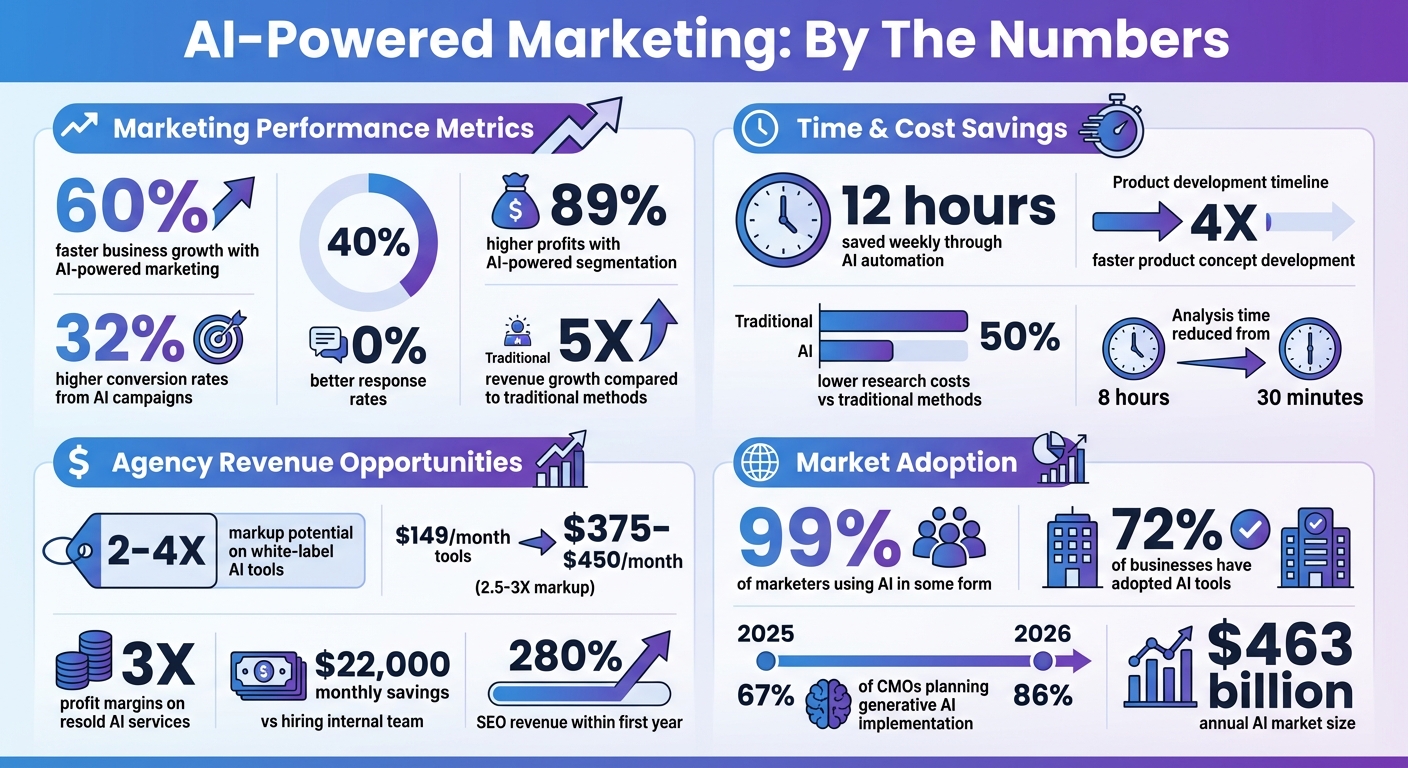
AI-powered marketing drives 60% faster business growth and boosts conversion rates by 32%. Agencies can resell white-label AI tools for 2–4× markups, creating scalable, recurring revenue streams while delivering high-value services.
AI transforms marketing by analyzing data in real-time, enabling businesses to identify market gaps, predict trends, and create hyper-targeted messaging. From micro-segmentation to automated A/B testing, AI helps brands stand out while saving time and cutting costs. For agencies, white-label AI services offer a profitable way to deliver enterprise-grade solutions without heavy investments.
Key Highlights:
- AI campaigns achieve 32% higher conversion rates and 40% better response rates.
- White-label AI tools can be resold at 3× profit margins, creating predictable revenue.
- AI-powered segmentation increases profits by 89% and saves 12 hours weekly.
- Predictive analytics shifts strategies from reactive to forward-thinking, improving ROI.
AI isn’t just a tool - it’s a game-changer for businesses and agencies looking to scale profitably. Let’s explore how AI reshapes marketing strategies and unlocks new revenue opportunities.
AI Marketing Impact: Key Statistics on Conversion Rates, ROI, and Agency Profit Margins
How AI is Transforming Marketing Strategies for Growth and Efficiency
sbb-itb-537ed4c
Using AI to Understand Your Market and Audience
AI has revolutionized market research by analyzing vast amounts of data to uncover patterns and insights that traditional methods often overlook. Instead of spending weeks on manual research that might still leave gaps, AI processes millions of data points to highlight opportunities where your messaging can make an impact.
AI-Driven Market and Competitor Analysis
When it comes to competitor research, AI takes the guesswork out and replaces it with data-driven precision. Advanced tools can sift through search trends, social media chatter, and customer reviews to identify "visibility gaps" - areas where your competitors are missing opportunities. This allows you to position your messaging strategically before others catch on.
Take competitor sitemap.xml analysis as an example. AI can dissect a competitor’s digital strategy by identifying their focus areas, such as service pages or geographic markets. By comparing this data to your own offerings, you can uncover content gaps where your business could stand out.
AI also dives into customer sentiment by analyzing reviews and social media, helping you understand how people feel about your competitors. With 68% of customers emphasizing the importance of trust in the age of AI, addressing trust-related gaps in competitor messaging could give your brand a critical advantage.
What’s more, AI shifts your approach from reactive to predictive. Instead of just analyzing what’s already happened, it forecasts future consumer behavior and emerging trends.
"AI can transform measurement's role in your marketing, helping you go from analyzing historical trends to acting on predictive insights." - Marie Gulin-Merle, Global VP of Ads Marketing at Google
Audience Segmentation with AI
AI reshapes audience segmentation by turning static buyer personas into dynamic micro-segments. It uses real-time behavioral data, psychographics, and customer pain points to create highly targeted groups. Through lookalike modeling, it identifies high-value prospects who share similar traits . Machine learning algorithms then rank leads based on their likelihood to convert, make a purchase, or churn.
These advanced segmentation techniques have driven impressive results, such as 5X revenue growth and 89% higher profits compared to traditional methods. Additionally, marketers using AI report saving an average of 12 hours per week by automating tasks that once required manual effort.
However, the quality of your data is critical. High-quality first-party data - like surveys, reviews, and loyalty program information - ensures accurate insights. Poor data, on the other hand, could waste over 10 hours a week. Reliable data enables AI to detect trends and opportunities that might otherwise go unnoticed by competitors.
With these insights, agencies can now offer white-label solutions to clients, packaging these advanced segmentation capabilities into scalable services.
White-Label Tools for Agencies
AI-powered market and audience analytics pave the way for agencies to use white-label tools that deliver branded, scalable insights. These platforms centralize data analysis, automate reporting, and allow agencies to provide clients with performance summaries, competitive intelligence, and segmentation insights - all under their own branding .
White-label platforms also enable agencies to offer "AI-as-a-Service", eliminating the need for additional specialized staff. You can resell these services, complete with your agency’s logo and domain, positioning yourself as a strategic partner rather than just another vendor.
Pricing models for these platforms often allow for healthy profit margins. For instance, a Growth plan costing $149/month can be resold for $375–$450/month, offering a 2.5–3X markup. Premium tiers for high-touch clients can yield even higher margins, with markups reaching 3–4X [innovaai.io].
The approach is simple: invest in enterprise-grade AI tools at wholesale rates, then repackage and sell them as premium services. Many agencies have found that white-label AI solutions not only streamline operations but also help scale value across multiple clients.
"Competitive advantage depends on having the most advanced generative AI." - IBM Institute for Business Value
Turning AI Insights into a Clear Value Proposition
Once you've gathered market intelligence using AI, the next step is turning those insights into a value proposition that connects with your audience. This isn’t about catchy slogans - it’s about aligning your strengths with your customers' needs in a way that feels credible and distinct. By leveraging insights from market and sentiment analysis, you can directly address gaps and opportunities uncovered in your research.
How to Build a Strong Value Proposition
Start by identifying customer pain points through AI-driven sentiment analysis. Tools like Natural Language Processing (NLP) can sift through social media posts, reviews, and feedback to uncover the emotions behind buying decisions. These emotional drivers often reveal what really matters to your audience.
For example, a chocolate brand used generative AI to analyze consumer feedback on Feastables, a new product launched by Jimmy Donaldson (MrBeast). The analysis showed that while the celebrity endorsement initially boosted sales, many customers were dissatisfied with the product’s quality. This insight highlighted an opportunity to explore celebrity partnerships without altering their core product - a strategic win.
Next, align your capabilities with emerging opportunities. AI can analyze competitor strategies and consumer trends to pinpoint where your product or service can fill unmet needs. For instance, a protein bar brand facing declining sales used generative AI to create 30 pre-validated product concepts. This approach was four times faster than traditional methods and helped reverse their sales slump by aligning the product’s value proposition with packaging preferences identified through AI.
Finally, refine your value proposition to make it both distinct and credible. AI’s ability to conduct competitor analysis ensures your offering stands out. Plus, with insights delivered up to four times faster and at 50% lower costs compared to traditional research methods, you can iterate quickly until you craft a proposition that resonates.
AI’s Role in Positioning and Proof Points
AI doesn’t stop at crafting value propositions; it also helps refine your positioning with data-backed proof points. Generative AI can draft positioning statements tailored to specific audiences, brainstorm messaging ideas, and adapt content to suit different cultures. The real strength lies in its ability to uncover precise, verifiable proof points.
For example, AI can analyze historical performance data - like which colors, calls-to-action, or image styles drive conversions - and suggest elements with the highest potential for success. A global insurance company used generative AI to analyze data and propose hypotheses for marketing tests. This approach cut the time to launch tests in half and reduced post-test analysis from 8 hours to just 30 minutes.
The goal is to move away from vague claims like "we improve efficiency" to specific outcomes like "we cut data analysis time from 8 hours to 30 minutes." That level of detail makes your value proposition both believable and memorable.
How Agencies Benefit from White-Label AI Solutions
For agencies, white-label AI solutions present an opportunity to turn strategic insights into profitable, scalable services. These platforms allow agencies to offer AI-powered research, sentiment analysis, and positioning frameworks under their own brand. For example, a $149/month Growth plan can be resold for $375–$450/month, delivering a 2.5–3x markup. Premium tiers for high-touch clients can yield even higher margins, with markups reaching 3–4x [innovaai.io].
White-label AI tools also enhance consistency across client deliverables. AI creative tools can be trained on specific brand guidelines, ensuring that every value proposition and proof point stays on-brand. This consistency allows junior team members to produce work that feels senior-level, freeing up strategists to focus on building stronger client relationships.
"The future of marketing is not a choice between humans and machines, but rather a new human-led and AI-empowered operating model." - Janet Balis, Vas Bakopoulos, and Lauren Wiener, BCG
With 76% of CMOs predicting that generative AI will fundamentally reshape marketing operations, agencies that adopt white-label AI solutions now can position themselves as strategic partners rather than task executors. By delivering tailored value propositions at scale, you set the foundation for impactful messaging across all channels.
Creating Differentiated Messaging Across Marketing Channels
Turning your value proposition into tailored messaging for email, social media, ads, and landing pages is a critical step in reaching your audience effectively. This process ensures your message resonates across platforms while staying true to your brand identity. AI tools can streamline this effort, helping you adapt your core message to fit each channel's unique requirements without losing your brand’s voice.
Developing Messaging Pillars with AI
AI can take your core value proposition and break it into messaging pillars suited for different platforms. Instead of manually tweaking your content for LinkedIn, Instagram, or Google Ads, AI tools can adjust the tone, length, and calls-to-action to match each platform’s style and audience expectations.
Take Carvana, for example. They used generative AI to create personalized videos for individual customer journeys. While the overarching message focused on hassle-free car buying, the details were tailored to each customer’s preferences.
To make AI work for your brand, you can train it using your proprietary data. As Jessica Ross from Monks highlights:
"True AI-powered differentiation comes not from the tools themselves, but from training them on your unique historical data, audience insights, and strategic knowledge".
By feeding AI tools with your tone-of-voice guidelines, campaign performance data, and visual branding rules, you can create a custom "Brand Brain" that ensures your messaging stands out. AI can also help with micro-segmentation, delivering highly personalized messages to specific audience segments in real time. For instance, Kellogg's used AI to scan trending recipes featuring breakfast cereal and quickly generated creative social media content aligned with those trends - keeping their messaging relevant without compromising their brand identity.
Maintaining Brand Voice and Consistency
One of the challenges with AI-generated content is the risk of it sounding generic or robotic. Modern AI tools address this by enforcing your brand guidelines automatically. Platforms like Writer and Jasper can ensure your messaging aligns with approved terminology, tone, and style.
This is especially important as businesses scale. Emerging workflows, such as agentic AI systems, involve specialized AI agents that handle insights, strategy, and content creation. These agents collaborate to validate your messaging against your brand’s identity before it goes live, acting as an automated quality control system.
AI-powered quality assurance tools further enhance consistency by checking for grammatical errors, inappropriate tones, or deviations from your brand voice before content is published. For agencies handling multiple clients, this automation ensures even less-experienced team members can produce high-quality work.
A great example is OneRoof, a property platform in New Zealand. By using the Braze Intelligence Suite, they shifted from generic property listings to localized recommendations, resulting in a 218% increase in total clicks on property listings and a 23% improvement in email click-to-open rates.
As of 2024, nearly all marketers (99%) report using AI in some form, with 67% of CMOs planning to implement generative AI by 2025 and 86% by 2026. The real question isn’t whether to use AI for messaging - it’s how to do so while preserving what makes your brand distinct.
AI Tools for Scalable Messaging
AI tools are also transforming how agencies scale their messaging efforts. White-label AI platforms allow agencies to manage multiple clients efficiently while maintaining control over branding and client relationships. These tools automate reporting and analytics, create content libraries, and deliver enterprise-grade AI capabilities under the agency’s own branding.
For example, Circus Group / Pazza Pasta used AI-driven recommendations and personalized paths to launch automated WhatsApp campaigns. This approach led to a sixfold increase in purchase rates for their weekly menu campaign compared to traditional email marketing. The AI optimized the timing and channel for each message based on customer behavior, choosing between WhatsApp, email, or SMS to maximize engagement.
White-label platforms offer agencies a way to provide advanced AI solutions while creating new revenue streams. They enable you to deliver personalized, high-quality messaging at scale without the expense of building custom AI infrastructure.
"AI won't write your messaging for you, but it can help you get there faster and smarter." - Stephanie Stocker, VP of Marketing, Conveyor Marketing Group
AI-powered messaging isn’t just about saving time - it’s about scaling personalization and maintaining brand differentiation. With predictions that agentic AI will handle 20% of marketing’s workload in the next few years, agencies adopting these solutions now can position themselves as leaders in delivering consistent, personalized messaging across every channel. For more strategies on scaling, explore our AI agency guides.
Optimizing and Refining Differentiation with AI Testing
Differentiated messaging can give you an edge in a crowded market, but only if it’s constantly refined based on real-world performance. AI tools make this process faster, smarter, and far more efficient than traditional methods.
AI-Driven A/B Testing and Performance Monitoring
Traditional A/B testing often feels like a waiting game. You split traffic evenly between two versions, collect data for weeks (or even months), and then finally declare a winner. By the time you act on the results, customer preferences might have already shifted. AI flips this process on its head with multi-armed bandit (MAB) testing, which dynamically reallocates traffic to better-performing options in real time.
Here’s how it works: AI doesn’t wait for a test to finish. Instead, it continuously shifts traffic toward the best-performing variant as data comes in. This approach slashes testing times from weeks to mere hours. For example, in October 2025, the food-waste app Too Good To Go used AI-powered testing through Braze to compare discount-focused messages with value-driven notifications. By integrating customer behavior with live supply data, they doubled their conversion rates and achieved a 135% increase in purchases from CRM campaigns.
AI also automates the creation of test variations. Advanced language models can generate dozens of headlines, calls-to-action, and copy options, saving you the time and effort of brainstorming manually. This means you can test more ideas, faster, and uncover what resonates most with specific customer segments - or even individual users.
| Feature | Traditional A/B Testing | AI-Driven A/B Testing |
|---|---|---|
| Speed | Weeks to months | Hours to days |
| Traffic Allocation | Static (50/50 split) | Dynamic (MAB testing) |
| Variations | Manually created | AI-generated at scale |
| Optimization | Post-test implementation | Real-time during the test |
| Outcome | Single winner | Continuous refinement |
AI doesn’t just stop at identifying a winner - it keeps refining and adapting messaging as new data rolls in.
Iterative Refinement of Value Propositions and Messaging
With AI, messaging evolves alongside market trends. Unlike traditional tests that end once a winner is chosen, AI-driven systems keep learning and adjusting to changes in customer behavior and competitor strategies.
Take Les Mills, the global fitness brand, as an example. In 2024, they used Google’s AI-powered Demand Gen campaigns to attract new subscribers. Over a four-week period, AI-optimized visual storytelling delivered 561% more sign-ups at a 72% lower cost per trial. Instead of sticking to a single winning message, the system continually adjusted creative elements to suit different audience segments.
AI also keeps an eye on what’s happening in the market. By analyzing customer reviews, social media chatter, and engagement trends, it identifies shifts in preferences and suggests updates to your messaging. This proactive approach ensures your value proposition stays relevant and ahead of the competition.
"AI changes the pace of experimentation - to the degree that A/B testing can be replaced by other real-time methods of experimentation and personalization." - Team Braze
Scaling Differentiation Services with AI White-Labeling
The constant refinement enabled by AI sets the stage for scalable, white-label services that can drive recurring revenue. White-label AI platforms let you offer branded, enterprise-grade testing and optimization services to multiple clients - all without needing to build your own infrastructure.
These platforms rely on multi-tenant systems, allowing you to manage multiple client accounts and AI models from a single dashboard while keeping data secure and separate. This approach enables agencies to bundle services like "AI Content Engine" or "AI Performance Optimizer" into branded packages with predictable deliverables and recurring revenue streams.
The financial upside is hard to ignore. Agencies using white-label SEO services instead of hiring a three-person internal team save an average of $22,000 per month. Even better, agencies that partner with specialized white-label providers report an average 280% boost in SEO revenue within the first year. By marking up these services by 2–4×, agencies can turn one-off projects into profitable, ongoing optimization programs.
White-label platforms also help agencies stay competitive without massive R&D investments. Providers continuously update their technology with the latest AI advancements, ensuring your agency stays ahead as new tools and capabilities emerge. With 73% of marketing agencies saying AI integration demands have outpaced their internal resources, white-label partnerships are no longer optional - they’re essential.
Conclusion: Accelerate Marketing Differentiation with AI
AI has grown into a staggering $463 billion annual market. While 99% of marketers are already using AI and 72% of businesses have adopted AI tools, the real game-changer lies in how strategically these tools are implemented.
Adopting AI isn’t just about keeping up - it’s about transforming how teams work. By moving away from manual processes, businesses can shift their focus to strategic planning and creative innovation. As Boston Consulting Group aptly states:
"The future of marketing is not a choice between humans and machines, but rather a new human-led and AI-empowered operating model".
This shift is delivering measurable outcomes. Companies investing in AI report revenue increases of 3% to 15% and sales ROI improvements ranging from 10% to 20%.
For agencies, white-label AI tools present a unique opportunity. These solutions allow agencies to offer enterprise-level capabilities under their own brand, enhancing profit margins and deepening client relationships.
What’s more, many agencies are taking AI integration a step further - leveraging proprietary data and fostering collaboration across teams to carve out a distinct competitive edge. By embracing AI for everything from automation to hyper-personalized marketing, agencies can position themselves for long-term success.
The tools and frameworks to achieve this are already available. By implementing them now, agencies can secure measurable results and build scalable, profitable futures.
FAQs
How can AI help businesses identify gaps in the market?
AI-driven market analysis processes an immense amount of data - like social media activity, customer feedback, and buying behaviors - to identify patterns that human analysts might overlook. By examining consumer sentiment and pinpointing recurring challenges, AI reveals unmet needs and opens doors for businesses to stand out in competitive markets.
On top of that, AI keeps a close eye on competitors, tracking moves like product launches, pricing changes, and promotional strategies. It flags areas where competitors may be underperforming or falling short on innovation. Predictive models take this a step further, forecasting upcoming trends so businesses can stay ahead of shifts and craft value propositions that truly make an impact.
What advantages do white-label AI tools offer for agencies?
White-label AI tools give agencies the power to offer advanced AI-driven solutions - like chatbots, predictive analytics, and automated workflows - under their own brand. The best part? Agencies don’t have to build the technology from scratch. This means they can quickly expand their service offerings, strengthen client relationships, and provide top-tier solutions, all while maintaining their brand identity.
With white-label AI, agencies can enjoy faster go-to-market timelines, better profit margins, and services that scale as client needs grow. These tools not only boost an agency’s reputation but also unlock new revenue streams by enabling premium, AI-powered offerings. The result? Happier clients, increased lifetime value, and lower operational costs.
Take Innova AI, for instance. It equips agencies with state-of-the-art AI solutions they can rebrand as their own. This ensures agencies stay ahead of the competition while leveraging reliable, scalable technology.
How does AI enhance audience segmentation and targeting?
AI takes audience segmentation and targeting to a whole new level by diving into massive datasets from sources like purchase history, browsing habits, and social media interactions. It doesn’t just stop at identifying patterns - it predicts what actions your audience might take next. Unlike traditional, rule-based approaches, AI creates dynamic audience segments that evolve in near real-time as fresh data rolls in. This means your messaging can stay on point and feel more tailored to each individual.
Using machine learning, AI reveals high-value opportunities, flags potential churn risks, and identifies emerging micro-segments that might otherwise fly under the radar. It can even incorporate external data - like market trends or sentiment analysis - to fine-tune targeting and boost campaign results. The payoff? Sharper targeting, improved conversion rates, and smarter allocation of your marketing dollars, all helping your brand stand out in a crowded market.