Predictive analytics can boost marketing ROI by 15–20% and lead conversions by 30–50%. It uses historical data to forecast customer behavior, helping businesses prioritize leads, allocate budgets, and reduce churn. By 2027, the predictive analytics market is projected to grow to $35.5 billion, making it a must-have for agencies and marketers looking to stay competitive.
Key benefits for agencies:
- Resell white-label platforms for 2–4× markup, creating recurring revenue.
- Automate data analysis, saving up to 200 hours per month.
- Offer branded dashboards to clients, positioning your agency as a leader in predictive marketing.
Quick Overview:
- Set Goals: Focus on measurable outcomes like customer retention or lead prioritization.
- Clean Data: Ensure accuracy, completeness, and consistency across platforms.
- Build Models: Use tools like regression or classification to predict outcomes.
- Integrate Predictions: Connect insights to CRMs, ESPs, and automation tools.
- Track Results: Continuously monitor and refine models to maintain accuracy.
By following this checklist, you can deliver data-driven insights, improve campaign performance, and increase client satisfaction - all while scaling your agency's offerings. Predictive analytics isn't just the future of marketing - it's the present. Let’s dive into the steps.
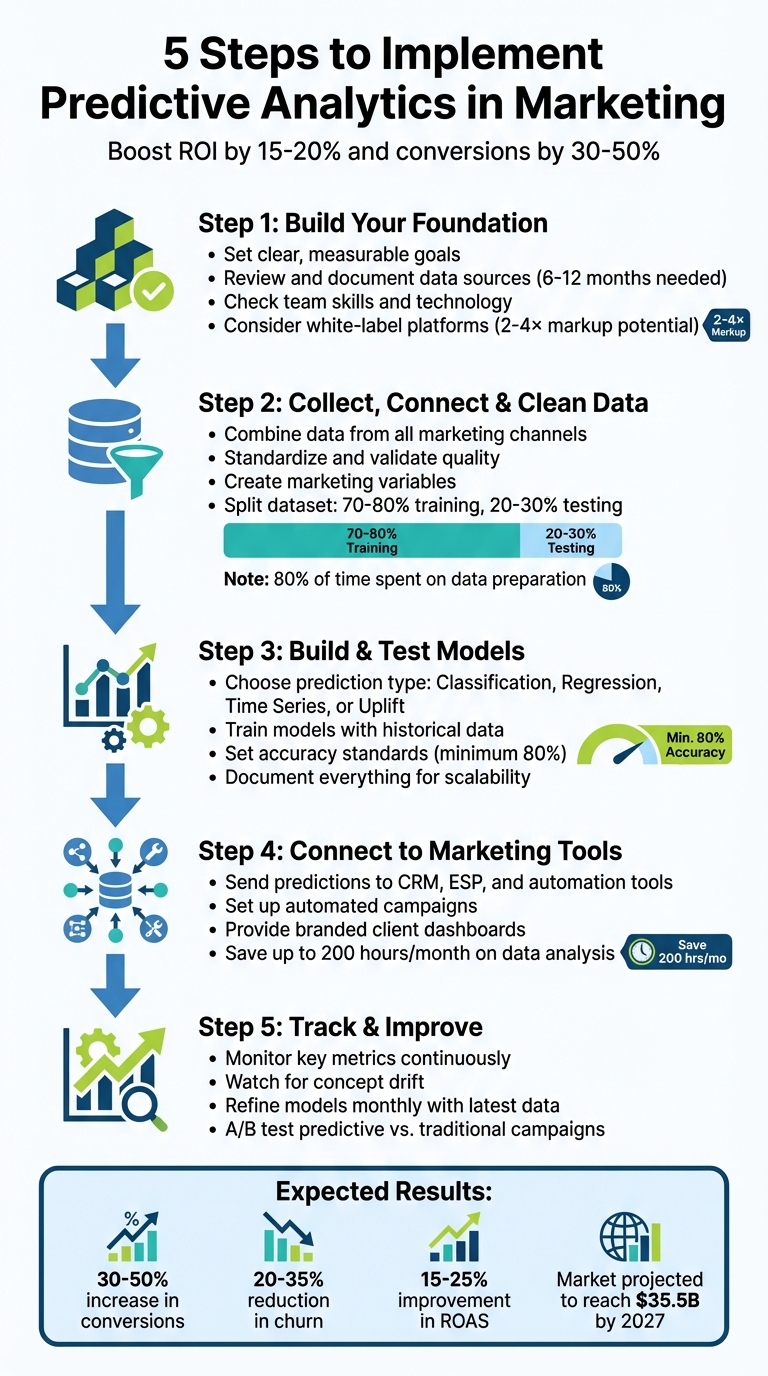
5-Step Predictive Analytics Implementation Process for Marketing Agencies
The Rise of Predictive Analytics in Marketing Strategy
sbb-itb-537ed4c
Step 1: Build Your Predictive Analytics Foundation
Creating a solid base for predictive analytics starts with clear objectives, a deep understanding of your data, and ensuring your team has the tools and skills to succeed. This foundation ensures accurate forecasting and scalability for your agency.
Set Clear Goals for Your Predictions
Focus on one specific, measurable outcome rather than trying to predict everything all at once. John Bates, Director of Product Management for Predictive Marketing Solutions at Adobe, explains:
"The first step is to understand the business objective. What are you trying to achieve? For example, are you trying to increase sales, reduce costs, or improve customer retention?"
Common predictive goals include:
- Customer retention: Spot at-risk clients by analyzing behaviors like decreased logins or increased support tickets.
- Lead prioritization: Rank prospects as hot, warm, or cold based on their activity and signals.
- Budget allocation: Predict which marketing channels will bring the best returns.
- Personalization: Estimate purchase likelihood or readiness for upsell opportunities.
- Operational efficiency: Save time by reducing manual data analysis.
Frame predictions as probabilities to guide decision-making. For example, "This lead has an 85% chance of converting within 30 days" provides actionable insights while managing expectations.
| Use Case | Business Impact | Typical ROI |
|---|---|---|
| Lead Scoring | Focus on high-value leads | 30-50% increase in conversions |
| Churn Prevention | Protect existing revenue | 20-35% reduction in churn |
| Budget Allocation | Maximize marketing spend | 15-25% improvement in ROAS |
| Product Recommendations | Boost average cart value | 20-30% increase in AOV |
Review and Document Your Data Sources
Compile a list of all platforms where customer data is stored - your CRM, Google Ads, Facebook Ads Manager, email tools, and web analytics. Centralize this information into a unified repository, such as BigQuery or a data lake.
Ensure your data meets these criteria:
- Accuracy: Does it reflect real-world events correctly?
- Completeness: Are key details like conversion dates included?
- Consistency: Is formatting uniform across all sources?
- Timeliness: Is the data recent enough to predict current behaviors?
You'll need 6-12 months of clean, historical data for reliable forecasting. Additionally, document compliance requirements, especially around personally identifiable information (PII) and consent. Remember, about 80% of the time spent on modeling will involve cleaning and preparing this data, so thorough documentation now will save time later.
Check Your Team Skills and Technology
Your team needs the ability to standardize data, understand statistical methods, and align predictive models with business goals. As Jeff Strickland explains:
"Predictive analytics is an area of data science that deals with extracting information from data and using it to predict trends and behavior patterns."
Confirm your team has access to:
- Secure storage for sensitive data.
- Data pipelines to move information between systems.
- Business intelligence tools for visualization.
If your team is new to predictive analytics, start small with time-series models in familiar tools like Excel. Gradually progress to more advanced platforms as confidence and expertise grow.
Additionally, implement role-based access controls to protect sensitive information. Ensure team members only access the data necessary for their specific tasks.
Use White-Label Platforms for Growth
White-label platforms offer pre-built infrastructure that allows you to deliver predictive analytics under your agency's branding. These solutions include branded dashboards and client-specific access controls, making it easier to provide analytics without the cost of building from scratch.
Compare the ROI of using a white-label solution versus developing in-house tools. White-label platforms can boost revenue, improve client retention, and strengthen your competitive edge.
For example, White Label AI Solutions offers scalable tools, including automation suites and dashboards you can resell at a 2-4× markup. Their Growth plan, priced at $149/month, enables agencies to charge $375-$450/month, creating steady recurring revenue while enhancing brand presence.
Leveraging a white-label platform not only supports agency growth but also positions your brand as a leader in predictive marketing.
Step 2: Collect, Connect, and Clean Your Data
Now that you’ve laid the groundwork with a solid analytics setup, it’s time to dive into the data. This step involves gathering, organizing, and refining information from every platform where your customers interact with your brand. The goal? To create a reliable dataset that improves the accuracy of your predictions.
Combine Data from All Marketing Channels
Start by pulling historical data from all your marketing platforms. This might include tools like Google Ads, Facebook Ads Manager, your CRM system (e.g., HubSpot or Salesforce), email marketing platforms (like Mailchimp or Klaviyo), and e-commerce platforms such as Shopify or WooCommerce. To make your dataset even richer, consider adding external factors like weather conditions, geographic data, or social trends. For instance, a Customer Data Platform (CDP) can help consolidate these scattered data points into unified customer profiles, offering a detailed view of each customer’s journey.
Here’s an example: A retail company might notice that rainy days drive an uptick in online orders for home goods or track social media chatter around a product launch to predict demand surges.
Whenever possible, automate the process of integrating data. Manual data transfers not only eat up time but can also lead to errors. Setting up automated pipelines to refresh your database regularly - whether daily or weekly - ensures you have up-to-date and accurate insights.
Once you’ve gathered your data, the next step is to make sure it’s clean, consistent, and ready for analysis.
Standardize and Validate Data Quality
Data from different systems often comes in varying formats, so the first step is standardization. For example, one platform might use the MM/DD/YYYY date format, while another uses YYYY-MM-DD. Similarly, currency fields should consistently use the dollar sign ($) and proper decimal formatting. Standardizing these elements ensures that your data can be analyzed without confusion.
Next, check for outliers and anomalies by setting acceptable ranges for your variables. For instance, if your average order value is $75, a data point showing $7,500 might signal an error - or it could be a bulk purchase worth investigating.
Missing data is another common issue. To address it, determine the pattern behind the gaps. If the missing data is completely random (MCAR), you can safely use listwise deletion. However, if the missingness is related to other observed data (MAR), multiple imputation is a better option as it maintains variance and reduces bias.
| Missing Data Mechanism | Definition | Suggested Action |
|---|---|---|
| MCAR (Completely at Random) | Missingness is unrelated to any specific factor. | Use complete case analysis (listwise deletion). |
| MAR (At Random) | Missingness is linked to other observed variables. | Apply multiple imputation to preserve accuracy. |
| MNAR (Not at Random) | Missingness depends on the value of the missing variable itself. | Model the missingness mechanism directly. |
To further refine your dataset, visualize it. Histograms and LOESS curves can help you spot non-linear patterns or skewed distributions. If you find a variable like session duration is heavily skewed, applying a transformation - such as a natural logarithm - can help normalize it.
Once your data is standardized and clean, it’s time to create actionable marketing variables.
Create Marketing Variables and Split Your Dataset
Develop behavioral metrics that reflect customer actions, such as purchase frequency, total spend, days since last interaction, website visits, and email click-through rates. You can also calculate derived metrics like Customer Lifetime Value (CLTV), churn risk, or conversion propensity scores. These variables allow for more precise customer segmentation and predictive modeling.
For example, a retail company worked with Lityx to build a churn prediction model using data like customer demographics, transaction history, and marketing engagement. This approach improved their ability to identify at-risk customers by 330% and boosted repeat purchase predictions by 265%.
Once your variables are ready, split your dataset into training and testing sets. Allocate 70–80% for training and 20–30% for testing. Random sampling is essential, and aim for at least 80% accuracy in the training phase before moving forward.
With a clean and well-structured dataset, you’re now ready to move on to building and testing your predictive models in the next step.
Step 3: Build and Test Your Prediction Models
Now that you’ve cleaned and organized your dataset in Step 2, it’s time to build models that can predict actionable marketing outcomes. This involves aligning your business goals with the right type of predictive models, training these models on real-world data, and testing their accuracy before putting them into action.
Choose What to Predict and Select the Right Models
The first step is to match your prediction goals with the appropriate model type. Here’s a quick guide:
- Classification: Best for binary outcomes like churn prediction or lead conversion.
- Regression: Ideal for forecasting numerical values like revenue or customer lifetime value.
- Time Series: Useful for tracking trends such as seasonal demand or budget planning.
- Uplift Modeling: Focuses on measuring incremental impact, like campaign effectiveness or reducing wasted spend.
Behavioral modeling is especially critical when forecasting buyer intent. As Don Simpson, CEO of Lift AI, explains:
"Identity doesn't equal intent, and pricing pageviews don't equal intent. Predicting who is truly ready to buy requires behavioral accuracy at scale".
Lift AI’s behavioral propensity scoring model is a great example. It achieves over 85% accuracy in identifying buyer intent, showing how this approach can outperform simpler methods.
When selecting your model, consider the balance between interpretability and accuracy. If your team needs to explain predictions to stakeholders, models like linear regression or decision trees are easier to understand. But if precision is your top priority, more complex options like neural networks or ensemble methods can deliver higher accuracy.
| Objective | Recommended Model Type | Marketing Use Case |
|---|---|---|
| Binary Outcome (Yes/No) | Classification | Churn prediction, lead scoring, conversion likelihood |
| Numerical Forecasting | Regression | Predicting Customer Lifetime Value (CLV), sales forecasting |
| Timing & Trends | Time Series | Seasonal demand planning, budget adjustment |
| Incremental Impact | Uplift Modeling | Testing offer effectiveness, reducing wasted spend |
Train Models and Test with Historical Data
Once you’ve chosen a model, use historical data to train and test it. A common approach is to allocate 70–80% of the data for training and the remaining 20–30% for testing. During training, apply cross-validation to ensure stability. This technique splits the training data into subsets, allowing you to train on one set while validating on another, rotating the subsets to minimize overfitting.
For accurate predictions, you’ll need a solid foundation of at least 6–12 months of clean historical data. Test the model by comparing its predictions to actual historical outcomes. For instance, if you’re predicting lead conversions, run the model on last quarter’s data and measure how accurately it identified conversions.
Real-world success stories highlight the potential of predictive models. For example, PointClickCare used Lift AI’s predictive intent scoring to identify high-intent website visitors. The result? A 400% increase in conversions and over $1 million in additional revenue within the first year.
Set Accuracy Standards and Document Everything
Before deploying your model in live campaigns, set clear accuracy benchmarks. In marketing, a common standard is achieving at least 80% accuracy. Track performance metrics such as error rates, accuracy percentages, ROC (Receiver Operating Characteristic), AUC (Area Under Curve), and Gini coefficients to evaluate your model’s reliability.
Documentation is equally important for scalability and future updates. Record details like data sources, transformations, and algorithm choices. Create a data dictionary to explain variables and any transformations applied, such as logarithmic scaling. Additionally, document your pseudo-code so that future team members can update the model regardless of the programming language.
For example, Twinings worked with Keen to develop a Bayesian-based model to forecast the financial contributions of various channels. By thoroughly documenting their methodology, they achieved a 16.5% increase in sales volume, a 28% revenue boost, and unlocked an extra $4 million in marketing investment.
Express predictions as probabilities to set realistic expectations. Instead of saying, “this lead will convert,” say, “this lead has an 85% probability of converting.” This approach helps teams understand the inherent uncertainty in predictions and manage expectations effectively.
Finally, schedule regular reviews - monthly or quarterly - to ensure your model remains accurate as customer behavior evolves. Christine Dolce, former Senior Digital Strategist at Acquia, emphasizes this point:
"Predictive analytics models are great, but they're ultimately useless unless you can actually tie them to your day-to-day marketing campaigns".
With your models trained, tested, and documented, you’re ready to integrate these predictions into your marketing systems, which we’ll explore in the next step.
Step 4: Connect Predictions to Your Marketing Tools
To make predictive analytics actionable, you need to integrate your models with the tools that drive your marketing efforts. This means connecting your platform directly to systems like Email Service Providers (ESPs), CRMs, websites, and Point of Sale (POS) systems. Without this connection, your predictions remain theoretical and can’t deliver real results.
Send Prediction Results to Your Marketing Systems
Feed predictive scores into your CRM and automation platforms to guide specific actions. For example, route high-intent leads to your sales team for immediate follow-up, while mid-intent leads can be added to nurturing campaigns. When it comes to churn prevention, use risk scores to trigger retention workflows - such as sending personalized discounts or scheduling proactive outreach.
You can also use "Propensity to Engage" scores to protect your marketing budget and maintain sender reputation. Exclude low-likelihood segments from expensive campaigns like direct mail, or reduce email frequency for contacts who might unsubscribe. This approach ensures your resources are spent where they’ll have the most impact.
By integrating these predictive insights, your campaigns can operate on autopilot, responding dynamically to data-driven triggers.
Set Up Automated Campaigns Based on Predictions
Take advantage of real-time, behavior-based segments to activate marketing responses instantly. For instance, set up automated retention offers for customers flagged as high churn risks or prompt fast follow-ups for leads showing strong conversion signals.
Proffsmagasinet, for example, achieved a 33% reduction in total email volume while doubling conversion rates by sending messages to the right audience at the right time. This proves that precision, not volume, drives results.
Automating these campaigns allows you to adjust budgets dynamically based on live performance data. Businesses that leverage predictive insights across all channels typically see a 15-20% boost in marketing ROI.
Provide Branded Client Dashboards
If you’re an agency or consultant, branded dashboards are a game-changer. Use platforms that support multi-tenancy to give each client their own secure data environment while operating on a shared infrastructure. Customize these dashboards with your agency’s logo, brand colors, and CSS-level tweaks to make the analytics feel like a seamless extension of your services.
For an even more professional touch, host dashboards on a custom domain like analytics.youragency.com. Avoid using iframes; instead, opt for JavaScript widgets to integrate reports into client portals, ensuring the design remains consistent. Features like drag-and-drop report builders empower clients to explore their data independently, reducing the need for technical support.
When selecting a white-label platform, go for flat-rate pricing to avoid scaling costs as your client base grows. Look for tools that offer CSS-level control, allowing you to align micro-animations and layouts with your agency’s design system. Automate workflows to send scheduled report previews or alerts when predictions hit specific thresholds.
Thousands of agencies and consultants have revolutionized their offerings with white-label technology. By adopting these solutions, you can launch faster, increase your profit margins, and provide scalable services - all while keeping your brand front and center. To learn more, visit innovaai.io and explore AI solutions tailored for agencies.
With predictive insights integrated into your systems and branded dashboards in place, you’re ready to track results and fine-tune your models in Step 5.
Step 5: Track Results and Improve Over Time
Once your predictive models are live, it’s crucial to keep a close eye on their performance and adapt as market conditions evolve. Compare metrics from before and after implementing these models to identify the specific improvements in conversion rates and ROI. This ongoing evaluation ensures your predictive models stay relevant, consistently delivering actionable insights to enhance your marketing strategy.
Track Key Metrics and Measure Impact
Focus on metrics that directly reflect business outcomes. For instance, predictive models often lead to:
- 30-50% increases in conversion rates for lead scoring campaigns.
- 20-35% reductions in customer churn.
- 15-25% improvements in ROAS for budget allocation.
- 20-30% increases in AOV for product recommendations.
Before fully deploying your models, validate predictions using a testing set (20-30% of your historical data) to compare them against actual outcomes. Schedule regular reviews - monthly or quarterly - to assess whether the model’s accuracy remains consistent or starts to decline.
Monitor Model Accuracy Over Time
Continuous monitoring is essential to ensure your models perform well over time. One key challenge is "concept drift", which occurs when real-world data begins to differ from the historical data the model was trained on. Keep an eye on three types of drift: prediction, outcome, and feature drift. For churn and conversion models, track metrics like the False Negative Rate and False Positive Rate, along with overall accuracy.
Establish clear thresholds for accuracy, with emergency stop conditions that trigger model retraining if performance falls below those levels. Regularly check for data issues, such as missing values or unexpected changes in data patterns, that could hurt performance. For example, a retail company working with Lityx achieved a 330% improvement in identifying at-risk customers by continuously monitoring and updating their predictive models.
Refine Models Using Performance Insights
Recalibrate your models every month using the latest 6-12 months of clean data to account for seasonal trends or changes in consumer behavior . Incorporate A/B testing to directly compare predictive-driven campaigns to traditional approaches, quantifying the added value.
RealVNC, for example, discovered through behavioral intent analysis that high-intent form fills generated 17.25x more revenue per lead than low-intent fills. By refining their targeting strategy, they identified 1,476 high-intent visitors who hadn’t filled out forms, ultimately driving 2.3x more revenue than all low-intent form fills combined. Focus on eliminating underperforming models and optimizing workflows that deliver results.
"Error will ultimately be what helps you to better understand your data and which actions lead to which results." - John Bates, Director of Product Management, Adobe
Human oversight remains critical, especially during major product launches or unique market shifts. Validate model outputs using domain expertise and leverage anomaly detection tools to flag unexpected performance spikes or drops. This quick response can make a significant difference. For example, PointClickCare increased chat conversions by 400% and added over $1 million in incremental revenue within a year by continuously refining their predictive models based on performance data.
Conclusion: Increase ROI with Predictive Marketing
By following each step - from establishing a solid data foundation to applying predictive models - you can unlock impressive ROI gains. Predictive marketing has been shown to boost ROI by up to 500%, and businesses optimizing across all channels often see a 15–20% lift in marketing ROI.
These strategies lead to measurable improvements in conversion rates, return on ad spend (ROAS), and reduced churn. Such results have the potential to redefine how marketing ROI is approached and achieved.
For agencies and consultants, white-label platforms provide a cost-effective alternative to building custom infrastructure, all while preserving your brand identity. By automating data consolidation, marketing teams can save up to 200 hours per month, freeing up time to focus on strategic initiatives. As Christian Watson, Co-Founder of Local Propeller, puts it:
"Predictive analytics will allow us to offer proactive insights, helping clients make more informed decisions without waiting for manual analysis. This shift will enable us to spend more time on strategy and optimization".
The growing reliance on predictive marketing highlights its importance. The predictive analytics market is projected to reach $35.5 billion by 2027, and by 2025, 75% of top-performing marketing teams are expected to use predictive analytics. The real question is no longer if you should adopt predictive marketing, but how quickly you can implement it to maintain a competitive edge.
Seize these opportunities to transform your business. Ready to elevate your white-label offerings? Join thousands of agencies, consultants, and solution providers who have reshaped their business models using white-label technology. Start offering enterprise-grade solutions under your brand today - no engineering required. The payoff? A quicker launch, higher profit margins, and a scalable service line that keeps your brand at the forefront while leveraging proven platforms to handle the heavy lifting.
FAQs
How does predictive analytics help maximize marketing ROI?
Predictive analytics takes marketing ROI to the next level by using data to anticipate customer behavior and pinpoint the most effective channels and prospects. With smarter targeting and optimized ad spend, businesses can achieve a 15–20% boost in overall ROI and see 30–50% higher conversion rates in lead-scoring campaigns.
By relying on this data-driven strategy, marketers can make quicker, more informed decisions, ensuring their efforts are concentrated on tactics that yield the best results.
What are the key steps to successfully implement predictive analytics in marketing?
Implementing predictive analytics in marketing can turn guesswork into actionable insights, paving the way for smarter strategies. Start by identifying the specific marketing challenge you want to tackle - whether it's improving lead scoring, reducing customer churn, or optimizing ad spend. Having a clear goal will guide the entire process.
Next, collect and prepare your data. Pull information from sources like your CRM, web analytics, or social media platforms, and make sure the data is clean, consistent, and ready for analysis. Quality data is the backbone of effective predictive models.
With your data in hand, the next step is to build and train a predictive model. Techniques like regression or clustering can help uncover patterns and trends. Validate the model's accuracy and make adjustments as needed to ensure reliable predictions.
Finally, put the model to work by integrating its insights into your marketing workflows. Use it to fine-tune campaign planning, personalize content, or make smarter media-buying decisions. Keep a close eye on the results and refine your approach over time to maximize ROI and keep your strategies aligned with your goals.
What are the benefits of using white-label platforms for predictive analytics in marketing?
Agencies stand to gain a lot by incorporating predictive analytics into their service lineup. These predictive models empower data-driven decisions, enabling clients to fine-tune budgets, enhance targeting strategies, and achieve higher conversion rates. By automating manual analysis, agencies can shift their focus to delivering strategic insights and offering more high-value services. In fact, marketers who embrace predictive analytics often see a 15-20% boost in ROI, with top-performing teams experiencing even better outcomes as adoption becomes more widespread.
White-label platforms simplify the process for agencies to integrate these advanced tools under their own brand, without the hefty costs or complexities of creating a solution from scratch. With a ready-to-use, enterprise-grade system, agencies can hit the ground running, maintain strong profit margins, and scale their services effortlessly. These platforms take care of the heavy lifting - like processing data, training models, and generating reports - leaving agencies free to focus on growing their business and providing cutting-edge solutions to their clients.